Originally published on Hackernoon.
For many of us, myself included, blockchain is still in that weird new, exciting, but really poorly understood space. It seems to be a tech-heavy solution looking for a problem and so is still rather gimmicky. We’re waiting for the ‘killer-app’ which helps people understand what it’s actually useful for.
This is perfectly normal. Society takes a while to learn about a new technology, and then how and when to use it. It happened when we learnt how to harness electricity, nuclear energy, computing, mobile phones, and no doubt the spinning Jenny, telephones, and the printing press. This is just how change happens.
So at the risk of looking like a complete idiot, I’m going to use this article to outline a few ideas I’ve had over the years and invite comment on their feasibility, because I can’t discern whether they’re ridiculous or brilliant, or perhaps a bit of both.
Some assumptions
It seems to me that one of blockchain’s most interesting uses is as a glorified loyalty card in which you can get points for doing various things. This is great because there are lots of things we do which should get points, but which society currently does not adequately incentivise (or punishes with ’negative points’). Pollution costs too little and we don’t make the polluter pay enough. Health and public health is another where the ‘reward’ (living longer) is too far away to make our monkey brains take decisions which are good for us in the long run. The current feedback loops are too weak to drive the changes we need, or would like to see.
This is a tragic flaw in the economic and regulatory systems we’ve inherited.
To look at a simplified model history:
- we traded locally
- then we needed to get more complex things done so we started to formalise traditional money (£$) to help that
- then we found that there were things (public goods) that we wanted but the free market didn’t provide very well (eg roads were poorly maintained and had highwaymen, education was clearly useful for society but hard for individuals to invest in)
- so we created Government to fill the gap to regulate and use taxes and incentives to nudge and cajole us along towards our shared goals.
That worked very well, and for hundreds of years societies grew more complex, business delivered more and better things to more people, health and education improved, population grew exponentially, and we even left the planet. If we think of civilisation as a series of levels in a game we’re playing together (exist → evolve → communicate → collaborate → grow → maintain, repair & enrich → leave planet → leave solar system → ..?), then generally speaking, humanity deserves a big pat on the back for doing really well at the ‘grow’ level.
Now the game has moved on to the next level: maintain, repair and enrich. Or to put it in other terms: ‘how to manage our success without letting our ambition destroy us’.
To do this we need to start thinking about—and measuring things—differently. R.F. Kennedy eloquently touched on this in his famous quote:
Gross National Product counts air pollution and cigarette advertising, and ambulances to clear our highways of carnage. It counts special locks for our doors and the jails for the people who break them. It counts the destruction of the redwood and the loss of our natural wonder in chaotic sprawl. Yet the gross national product does not allow for the health of our children, the quality of their education, the intelligence of our public debate or the integrity of our public officials. It measures everything in short, except that which makes life worthwhile.
And for the last few decades we’ve been doing really well at decoupling economic growth from resource consumption:
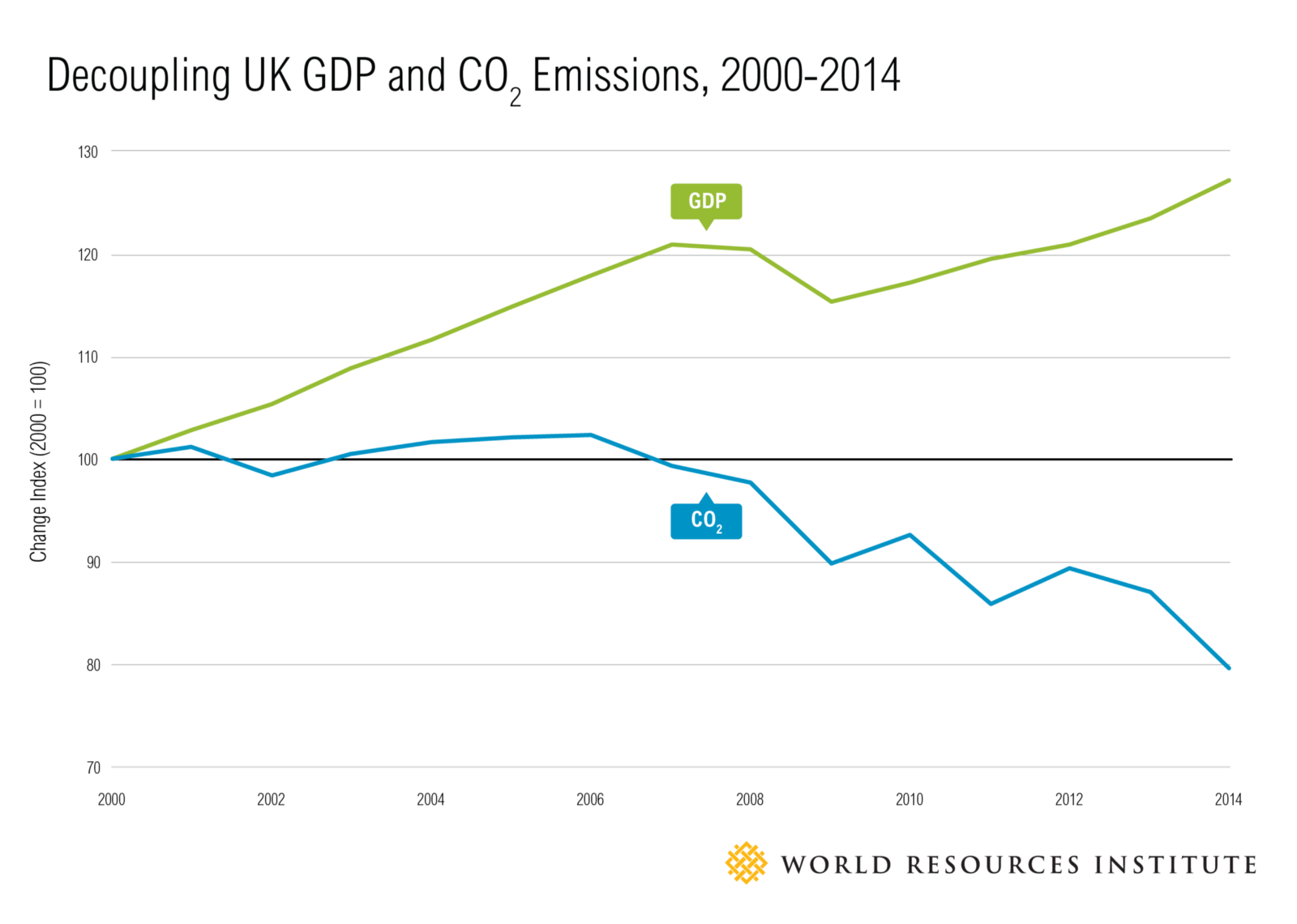
But we’re not doing brilliantly at it. Our challenge is to make all the lines in this graph go down and to the right. But right now, they don’t:
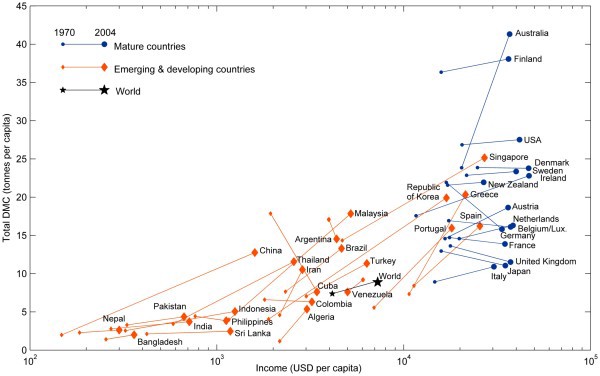
Right now we’re on track to fail this level because we’re well on the way to destroying our life support systems whilst having increasingly meaningless lives.
What blockchain does nicely is allow us to reinvent how we think about what money is and does, and what it values and why, and use these new ’loyalty card’ mechanisms to measure, account, and trade different commodities and values in new ways.
Right, that’s enough rationalisation. On to the hypothetical examples.
1. Medicoin

The key to solving a lot of medical problems lies in a better understanding of genetics. The more DNA data we can gather and analyse the more problems we’ll solve.
We’ll be faster and better at finding cures and treatments if we can tie individual DNA to lifestyle and monitor outcomes over time (ie who gets which disease, when, and how their body deals with it and responds to what treatment).
Iceland is already cracking on with this: 1/3rd of the population has donated their DNA for research. Many papers have already been published based on the data and trials are underway for new Alzheimer’s treatments. Thanks, Iceland!
But their data is anonymised, reducing its potential, and people have little incentive to participate.
Blockchain to the rescue.
We can make a system so that when you give your DNA you are registered and given 20,000 Medicoins. Your DNA is unique so you can only do this once. This elegantly solves a fairness of allocation problem—it’s not just the rich early investors who benefit, and we all participate equally.
You can use Medicoins just as you would use money. They are stored in your wallet and you spend and transfer them as you wish.
Every 3 months you are asked a series of quick simple questions about your health. Every time you do, you get an extra 100 Medicoins.
If you like, you can think of this whole thing as being a basic income system, but with a bit of a quid-pro-quo. You get ’thanked’ in Medicoins just for being a good person who is contributing to the public good.
We can further incentivise it by adding bounty prizes: if your DNA contains a sequence which cures cancer you’ll get enough points to retire comfortably.
I really like this idea because it deals with fair allocation, provides a basic income model coupled to purposeful civic participation, and makes sure that computational power does something worthwhile.
2. RailCoin

Let’s do an ICO to buy a rail company and run trains.
In the UK we have a system where private companies can win a licence to operate trains on public tracks. Which means that what follows is actually possible.
- Launch an ICO to raise boatloads of money.
- Buy a rail franchise and rolling stock etc.
- Make the service kick-ass with good wifi and plenty of space and coupled with free bike rental etc—all the good innovations you’d expect if you were making a sensible and joined-up transport system.
- Use the RailCoin to give preferential treatment to those who invest in the future of the RailCo.
- Use the personal relationship and incentive mechanisms to optimise the system.
Basically this is cooperatively owned and run rail company, with additional benefits for members.
So let’s say you buy 10,000 RailCoins for the same price as you’d currently pay for a season pass for two years. By being an investor you get 10% off your tickets, get preferential access/speeds on wifi, have a free hot drink on each journey, discounted/extended free periods on bike hire, etc.
Because you have a personal travel wallet holding your RailCoin, and because that’s personalised to you, the RailCo can also start to play with ticket prices in a more agile and intelligent way to work with you to smooth out demand.
By having a personal relationship RailCo can tweak incentives: “Hey Jo, it’s raining today so demand is higher because fewer people are cycling. If you can work from home, brave the weather and cycle, or travel after 10am we’ll give you 5 RailCoins to use on any off-peak journey.”
3. BasicIncome / Generational Inequality Coin
How about we just give everyone 30,000 BIGICoins each year and see what happens?
The key difference between this and all existing universal basic income experiments is that this is new money supply. So it won’t reduce any existing benefits, it sits alongside them. We don’t have to wait for Government to sanction it, it’s not coupled to the national currency, and it can find its own value by the trades we make with it.
As a twist, let’s just give it to everyone under 30 (born after 1987). They’ll be more tech savvy so easier to work with, more open to new ideas, and could really use a break economically.
4. UnburnableCoin
Between 60–80% of known coal, oil and gas reserves of publicly listed companies are ‘unburnable’ if we’re not to exceed global warming of 2°C.
But the value of these fossil fuels is already accounted for as an ‘asset’ on these companies’ books, so people are trading and investing and making decisions on the idea that it will be used. If it’s not, these companies lose their value and everyone’s pensions take a hit.
Known as ‘stranded assets’, their estimated value ranges from $4 trillion to $100 trillion. Which we can’t burn.
Moreover, the world spent $674 billion last year to find and develop new potentially stranded assets. Which we can’t burn.
Fossil fuel companies find themselves pushed into a corner without an exit strategy and so fight tooth and nail to resist legislation and innovation.
Blockchain to the rescue.
- Leave the fossil fuel where it is
- Create $4tn of UnburnableCoin. This can ONLY be spent on clean energy generation or trade.
- Give $3tn to the fossil fuel companies so they have an exit. Maybe add some additional rules so they can only use this for investing in new clean energy generation capacity.
- Reduce the $674bn to $400bn as an annual top up to UnburnableCoin, and use the $274bn for other Good things.
- CO2 emissions and pollution plummets, energy gets cheaper, world gets nicer.
NB this is not quantitative easing. This is substitution of useless money with useful money.
5. EcoCoin
Declare and agree that gold has value and people will endure huge amounts of hardship to go dig it up. Say that plastic bags each have a minimum cost of £0.05 and suddenly those bags under your sink go from being £0.0000001 of recyclable plastic to being worth £1.45—a value vastly higher than their cost.
What would happen if we said that trees (which reduce CO2 and thus reduce global warming) have a value much higher than their cost? We’d go plant trees. Want to get rich quick? Plant trees. Unemployed and want to make a buck? Plant trees.
Trees alone isn’t a sufficient metric of course. Biodiversity generated, longevity, type and location of the trees would add or reduce value.
An EcoCoin currency lets you do clever things like multiply its value by current CO2 levels. Our target is 350ppm, so we can prime the market by saying that if the CO2 level is over 405ppm then the EcoCoins earned for new trees will be 2x what they will be when it’s 350ppm. So you get a lot of early action to avert later disaster.
The Shepherd Tone economy?
One last concept. It’s a bit weird, but I can’t help but feel there’s something in it.
The economy depends a lot on the concept of growth. Infinite growth on a finite planet isn’t going to work. This is why humanity’s been trying to decouple growth from resource consumption.
Can we have an economy which infinitely goes up and to the right to please the economists and to keep progress ticking along, but does so without expanding?
There’s a great concept called the Shepherd Tone. You might recognise it from club music when you’re waiting for the break and the tone is going higher and you’re dancing harder because that break has GOT TO COME SOON and it keeps on rising, and you dance harder and it just GOES ON FOREVER.
Could the economy do the same thing? In many ways it already does: we have inflation which adds zeros but doesn’t make the houses bigger. But could we do it more intelligently? Could we, for example, have coins for all of the things on this diagram, and then cycle around between them?
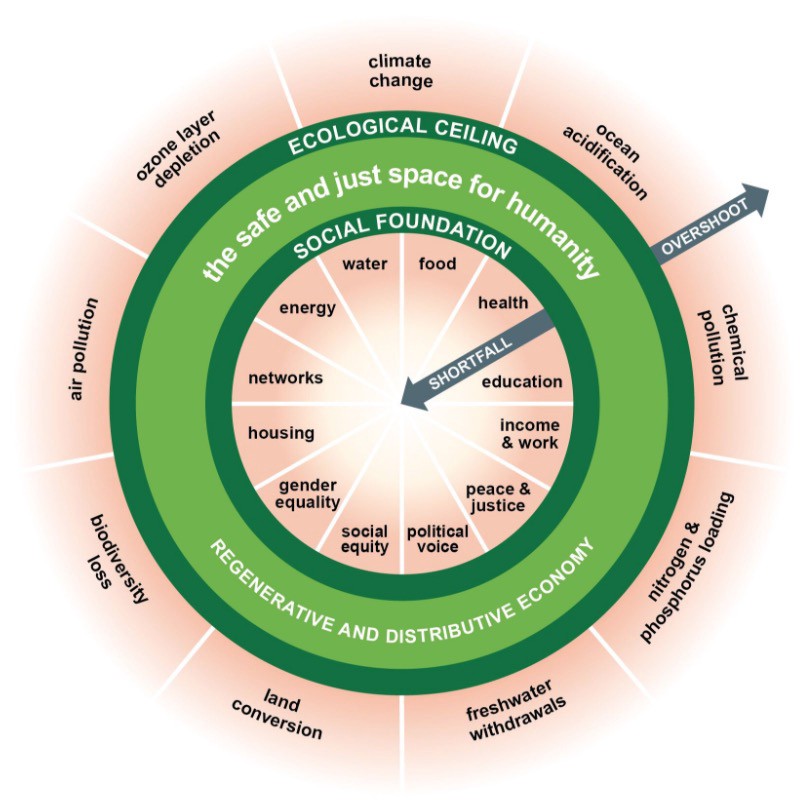
Maybe not all coins should be exchangeable
We have a massive proliferation of new currencies at the moment. But how many do we NEED?
Perhaps we only really need, say, 12 coins to value everything. If £$€ can be broad enough to value canoes and cokes and shoes and houses, so we’ll maybe only need one for each category of thing £$€ doesn’t value. One for health, one for environment, and so on.
Perhaps we might make rules which say that you have to hold a positive balance on each of these 12 accounts for any one of them to work. You’re a human living in a public world on a finite planet, so part of the deal—part of the social contract—is that you have to make a positive contribution across all 12 areas.
So there you go. Bunch of ideas. What do you think?